|
 |
| Vineeta and Divyesh Muni try to capture the interplay of unusual colours in the Himalayan landscape in their work (top) |
For photographer Sankar Sridhar it all began after an arduous trek to Gochala in west Sikkim in 1994 at the age of 16. He was hooked instantly and he returned soon afterwards to climb two 21,000-ft peaks in Ladakh and to take photographs along the way. Over the last few years, he’s criss-crossed the state, travelling there about 54 times. He has already turned out a book on Ladakh and he’s currently working on two more books — one on its lakes in winter and another on the Gaddi tribes of Himachal Pradesh.
Or take a look at Mumbai-based climber-photographer couple Vineeta and Divyesh Muni who’ve been trekking and clicking pictures ever since they were teenagers. In 1985, Divyesh (at the age of 19) climbed Mt Kamet, and in 1997 Vineeta along with eight other women did a rigorous 4,500km trek from Arunachal Pradesh to the Karakoram Pass that took over seven months. The couple’s photographic journeys were on display till recently at a show called Himalayan Mystic at Mumbai’s NCPA. “Our photography is spontaneous,” says Vineeta, who insists that they are mountaineers first and photographers only second. The Munis are planning another photographic-expedition to Ladakh in August.
 |
 |
| Sujoy Das (above) has focused on Himalayan flora and fauna since 1986 |
Sridhar and the Munis are part of the growing tribe of photographers who are turning their lens on the Himalayan landscape and capturing the jagged peaks and distinct lifestyle of the region. They are leading expeditions into the higher reaches of the Himalayas, holding photo exhibitions and putting together lavishly produced books.
Cut to Rahul Sud, 39, from Kullu who’s been photographing the region for 10 years now. Initially, he concentrated on the tree-line areas (below 9,000ft). Then, he shifted focus to higher altitude regions (abo-ve 10,000ft). Some years ago Sud held his first exhibition at the Roerich Art Gallery in Manali and more recently he published his first coffee-table bookKullu — Beyond Horizons.
“The idea was to embark on a photographic journey to capture uncharted routes and villages,” he says. In this book, he’s clicked lakes like the Beas Kund (13,000 ft) and the Bhrigu Lake (14,200ft) and scenic spots like the Tirthan Valley with its fast-flowing mountain river. Up next are two more book projects — one on the Great Himalayan National Park and another on the Parvati Valley.
Photographers who focus on the Himalayan region have plenty to turn their lens on — the varied scenery, the people or just the breathtaking sunrises and sunsets. Says Deepak Bhimani, mountaineer and treasurer of the Himalayan Club, Mumbai: “The Himalayas have something for everybody — the adventurer, photographer, painter and spiritualist.”
 |
 |
| Sankar Sridhar (above); pic by Jagan Negi is working on two new books — one on the lakes in Ladakh in winter and another on the Gaddi tribes of Himachal |
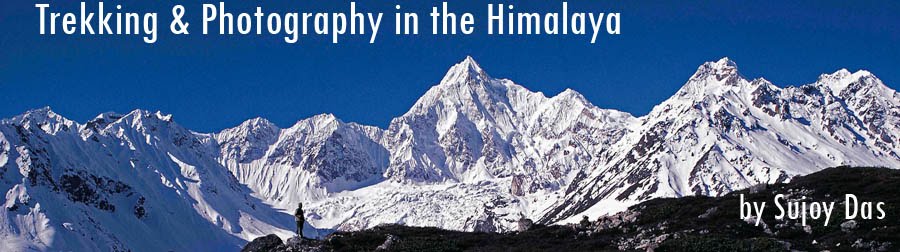
There’s also Calcutta-based photographer Sujoy Das who’s been capturing the Himalayan flora and fauna and its cultural life ever since 1986 when he climbed the Dorji La (18,644ft) peak in north Sikkim. He says: “There was always a curiosity to find out what lay behind the next hill and across the next pass. That remains with me even now.”
In 2001, his coffee-table book Sikkim — A Traveller’s Guide, co-authored by Arundhati Ray, was the finalist at the Banff Mountain Book Competition in the Adventure Travel category. Currently, Das is working on another book on the Indian Himalayas. He’s also set up South Col Expeditions in Calcutta that runs treks and photo workshops in the Himalayas.
Most of these photographers go beyond just snapping away with their cameras. For instance, Mumbai-based photographer Atmaram Parab, who’s been to Ladakh 84 times, takes amateur photographers into the mountains. Parab has set up a club, Wanderers, which has 130 members, and also has a photo-tours company, Isha Tours.
At a different level, what started as a hobby for Shimla-based Himanshu Khagta is now a vocation. He’s currently shooting in the Churdhar region of Himachal Pradesh. In August, Khagta will be doing a month-long trek to Ladakh.
 |
 |
| Rahul Sud (above) has been photographing the Himalayas for 10 years now |
Of course, funding is still a big problem. Most of the expeditions are self-financed by the photographers. Says Divyesh: “The Everest expedition is the most expensive and costs about Rs 25 lakh per person. A trek to any other of the Greater Himalayan peaks will set you back by Rs 3 lakh per head.” So Sud raises money for his treks from his own hotel business and Vineeta is a commercial artist. Divyesh is a practicing chartered accountant.
In recent years, Himalayan photographers have discovered a greater demand for their images. So while the Munis recently showcased their work at the NCPA, Das showcased his at various art exhibitions in New Delhi and Calcutta. Sridhar’s photographs too have been exhibited across India and fetched him awards. His photographs of a winter trek across the frozen Zanskar river fetched him the Best Mountain Adventure award at the Banff Mountain Festival in 2009.
And these shutterbugs have armed themselves with right qualifications. Sridhar and the Munis have done advanced courses at the Nehru Institute of Mountaineering in Uttarkashi. And Vineeta also did a three-month photography course under Mumbai-based portraitist Beli Homjee.
Inevitably, every photographer is trying to develop a unique style. Sridhar’s focus is on the unusual. He says: “Since Ladakh gets minimum snowfall even in the high winters, I once waited for snowfall and was out there at sub-zero temperatures to capture it. Nowadays, I tend to go against the very grain of traditional landscapes to concentrate on fleeting moments in the play of light and shadow.” There’s also Sud who likes to apply radical techniques, like giving the clouds an almost surreal look. He says: “This blurring technique is achieved by using slow shutter speed. This is done by placing a filter in front of the lens to block light.” He also shoots broad panoramas, some even spanning 360 degrees.
 |
 |
| Himanshu Khagta (above) is a self-taught trekker and photographer |
The Munis on the other hand try to capture the interplay of unusual colours of the Himalayan landscape. Vineeta reminisces: “When we were at the Chong Kumdan glacier (on the lower slopes of Karakoram), one evening the light became stunningly purple and we immediately started clicking.”
Though the technicalities of being a Himalayan photographer are easier now thanks to smaller digital cameras, most photographers say the older analogue cameras were better. Says Vineeta: “Some of the best photography has been done with those cameras. But due to the high processing cost, we’ve now switched to digital ones.” So while Das still uses the Nikon F3 HP and the Nikon N90S, Sud uses a Nikon F80 and Sridhar too votes for his earlier Nikon F80 and F100 cameras.
There are other challenges too. You must be able to withstand freezing temperatures, be persevering and be able to do lots of walking. Vineeta recalls breaking a few bones while climbing. Sridhar remembers miscalculating the depth of a swollen river in the Kangra Valley and losing his camera bag while crossing it.
Even then there are moments that every photographer cherishes. Das, who’s been to the Everest four times, reckons that his winter ascent of Kala Patthar peak in 2004 was one such. “We were a two-man team. As we crossed the pass before Pheriche (14,340 ft) a snowstorm started and we took shelter in a lodge. We were cooped up for almost 36 hours as all trails were obliterated. Finally we followed a shepherd with a yak caravan all the way to the Khumbu valley and the base camp.” But it all paid off. Says Das: “As we reached the top, the clouds cleared and I started clicking the ethereal sights of the Himalayan giants like Everest, Nuptse, Pumori, Ama Dablam and Khumbutse. I’d never seen a view like that before.”
Roughing it out is, of course, part of the game. Sud says it’s treacherous photogra-phing mountain brooks during the monsoons as there’s the danger of slipping on the rocks. And Sridhar says doing the Chadar trek in Ladakh was one of the scariest things he’s done. “I once fell 60ft into a gorge. The locals fished me out with the help of sticks.”
For Sridhar, the biggest difficulties while trekking to Changthang (the high-altitude plateau with temperatures freezing at -48°C) was keeping his water-bottle and camera batteries warm. He says: “I used to wrap my bottle in layers of woollens. I had little pockets sewn in my vest to keep the batteries close to my body. Also I carry 10-12 days of food and fuel because getting help in those regions is out of question.”
So what are the cardinal rules in the field? Says Sridhar: “Don’t offer the local people money. Carry food, fuel, shoes and clothes instead. And always carry solar panels to charge your batteries.” Adds Divyesh: “A little fear is also good in this field because that’s what keeps you cautious.”
|