|
 |
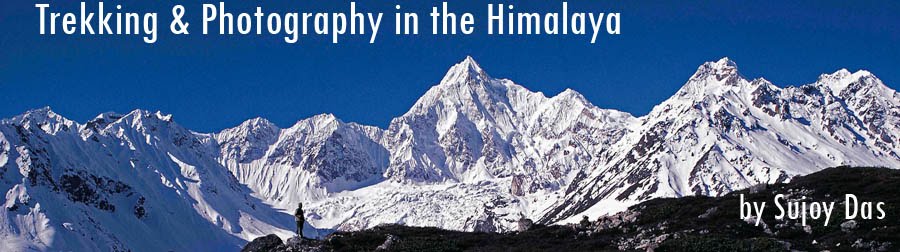
| Mount Kangchenjau, in whose shadow Kellas (picture below) is buried. (Picture by Sujoy Das) |
On June 5, 1921, on a windswept plain in Tibet, Lt-Col. Howard Bury, the leader of the Mount Everest Reconnaissance Expedition, had a very unhappy task to perform. He was to preside over the last rites of Dr Alexander Mitchell Kellas, 53, who was the first casualty of the expedition and died before the team could reach the foot of Mount Everest. So, with Bury reading from the Corinthians, surrounded by his team of Everest climbers and the Sherpas, Kellas was buried near the Tibetan fortress of Khamba Dzong in the shadow of the three mountains which he alone had climbed — Kangchenjau, Pauhunri and Chomiomo. As the team made its way to the Rongbuk base camp, one of the finest mountaineers of his generation passed into oblivion.
Kellas was no ordinary mountaineer. He was a Scottish doctor of chemistry, an expert in high-altitude physiology and, above all, a Himalayan explorer. He was the first to promulgate the theory that it would be possible to ascent Everest without artificial oxygen in his pioneering paper A consideration of the possibility of ascending Mount Everest. Fifty-eight years later, in 1978, Reinhold Messner and Peter Habeler proved Kellas right when they made that epic first ascent, the climbers gasping for breath and crawling on all fours along the final summit ridge.
Kellas was born in Aberdeen, Scotland, in 1868 and studied at University College, London. He travelled to Heidelberg, Germany, for his PhD and returned to take up a lectureship at Middlesex Hospital, where he was highly regarded as a chemistry teacher. But his first love remained mountaineering and exploration.
Kellas was reclusive to a fault and wrote very little about his exploits. He undertook eight Himalayan expeditions between 1907 and 1921. Six of them were in Sikkim, where he made the first ascents of Pauhunri (7,128 metres), Chomiomo (6,829 metres), Sentinel Peak (6,470 metres), Langpo (6,950 metres) and Kangchenjau (6,920 metres), assisted solely by Sherpas. On his first Himalayan expedition in 1907, Kellas had hired Swiss guides, but he soon realised he preferred the Sherpas from Darjeeling. “Really, they are the most splendid fellows,” he wrote. “They are strong, good-natured if fairly treated and since they are Buddhists, there is no difficulty about special food for them — a point surely in their favour at high altitudes.” It was primarily due to Kellas’s pioneering efforts that links were formed between British mountaineers and the Sherpas, which became the backbone of all Everest expeditions since 1921.
In 1920, Kellas undertook an expedition to Kamet in the Garhwal where, along with Henry Morshead, he tested oxygen equipment at high altitudes in preparation for the first Everest expedition the next year. Kellas would possibly have climbed Kamet had it not been for a porters' rebellion. Morshead later climbed up to 7,650 metres on Everest in 1922 accompanied by Mallory, Norton and Somervell.
In 1921, as a run-up to the Everest expedition, Kellas and a team of Sherpas made an unsuccessful attempt on Kabru (7,338 metres) in the Sikkim Himalayas. Nine days later, a weary Kellas started out on the Everest expedition to Tibet, which would be his last.
Tom Longstaff climbed Trishul (7,120 metres) in 1907 and supposedly held the high altitude record until 1930. But it was later proved by Kellas's biographer Ian Mitchell that the record belonged to Kellas, as Pauhunri, which he climbed in 1911, was eight metres higher than Trishul.
In 1930 the Kangchenjunga expedition led by Gunther Dyrenfurth had named a shapely 6,680-metre peak north of Jonsong as Kellas Peak. This peak, interestingly, is unclimbed till date and in 2009 a team of British mountaineers including Graham Hoyland and George Rodway, were able to reach the Kellas Col at 6,380 metres, where avalanches and crevasses prevented them from making a summit bid.
Kellas has always been overshadowed by the likes of Mallory, Smythe and Shipton, but Everest historian Walt Unsworth in his epic Everest - A Mountaineering History, wrote: "In terms of Himalayan experience he [Kellas] was the greatest of all."
Kellas’s years in anonymity may now end. The story of his life has been documented inPrelude to Everest: Alexander Kellas, Himalayan Mountaineer, by Ian R. Mitchell and George Rodway, published in 2011. It should finally give the explorer his deserving place in the annals of mountaineering.
|