Wednesday, May 29, 2019

Everest | The First Ascent May 29th 1953

Hillary and Tenzing aftter the successful ascent May 29th 1953
Today is sixty six years since the first ascent of Everest.

On 29th May 1953 at 11.30 am, a Sherpa and a New Zealander became the first men to stand on top of the highest peak on this planet.  However the intervening years has seen a sea change as far as Everest is concerned. The mountain   has now become a playground for guided expeditions, with clients paying between thirty thousand  to  eighty thousand dollars or more to stand on the highest point on earth. The South Col route climbed in 1953 is now disdainfully referred to as the “yak trail”. The dangerous icefall below the Western Cwm is maintained by a team of sherpas right through the season led by a senior “Icefall Doctor.” 


In order to make it possible for the clients to summit Everest, the entire mountain has fixed rope from bottom to top and the first to summit each year is a Sherpa team.


Kami Rita Sherpa created a new record this year by summiting Everest 24  times - in the last week he has summitted Everest twice in the 2019 season -  the most by any climber breaking his own record of 22 summits. I wonder if anyone will break Kami's record - maybe Kami himself next year!

 This year 2019 has not been a very good one on 8000 metre peaks. At the time of writing,  there have been 20 deaths on 8000 metre peaks this season - Everest, Makalu  Kangchenjunga  and Cho Oyu. There were also reports in social media and newspapers that more than 200 climbers were in human traffic jam on the south east ridge of Everest near the balcony area and as a result of this some climbers lost their lives due to exhausion  and many others had injuries due to frostbite from waiting in the "deathzone" for so many hours. There have been ten deaths on Everest so far. 

However, this post recounts through photographs,  the 1953 climb, the historic ascent of the first two men to summit Everest and the team of climbers and sherpas who supported them through this endeavour.

Bourdillon and Evans on their return from the South Summit on May 26th 1953 - Bourdillon had wanted to make a push for the summit

Nawang Gombu crossing the icefall ladders - Gombu later became the first man to climb Everest twice in 1963 and 1965
The five men who helped  Hillary and Tenzing to carry to Camp 9  27,800 feet - John Hunt, Da Namgyal, Alf Gregory, Any Nyima and George Lowe - Photo George Lowe Collection

The map of the Khumbu icefall and the route followed by the 1953 expedition


From left: John Hunt, Ed Hillary, Tenzing, Ang Nyima,  Alfred Gregory and George Lowe after the ascent

The code which was later used in the telegram to send the news before the Queen's coronation

The telegram sent by John Hunt after the ascent

Hunt, Hillary and Tenzing in London

The full expedition team with the sherpas
Tenzing and his mother at Tengboche monastery after the climb
Tenzing and Hillary at Tengboche monastery after the successful climb
Sketch map drawn by Tenzing for his biographer James Ramsay Ullman 

The signed colour supplement of The Times


All photographs in this post are copyright the ROYAL GEOGRAPHICAL SOCIETY and the respective owners. This post is non-commercial. 

Wednesday, May 22, 2019

Everest | The West Ridge & the First Traverse May 22nd 1963


Today is the 56th anniversary of the first ascent of the West ridge of Everest and the first traverse of the mountain.

On 21st May 1963 at six o’clock in the evening two climbers reached 27,205 feet (8300 metres) to set up Camp 5W on the west ridge of Everest. Tom Horbein a US anesthesiologist then 32 years old and Willi Unsoeld , a mountain guide then 36 years of age were poised for the final push to the summit of Everest by a new route.

It had not been easy for these two men. The 1963 American Everest Expedition led by Norman Dyhrenfurth had squarely set its sights on a first American ascent by the South Col route. On May 1st 1963, Jim Whittaker accompanied by Sherpa Nawang Gombu, Tenzing’s nephew, made the first American ascent to become the fifth and six men to stand of the summit after the British in 1953 and Swiss in 1954.

Photo Courtesy - outsideonline.com
But Horbein and Unsoeld had other ideas. Working doggedly with the meager resources including limited oxygen the duo set up camps on the virgin west ridge route.

On the day of their summit climb, Barry Bishop, a National Geographic photographer, and Lute Jerstad were also attempting the summit by the South Col route. Bishop and Jerstad reached the summit around 4 pm but did not find any evidence of the west ridge team who were still two hours below the top.

Horbein on the West Ridge- Photo Courtesy Willi Unsoeld
The West ridge pair  reached the summit at 6.15 pm on 22nd May 1963 and became the 11th and 12th men to climb Everest and the fifth and sixth of their expedition. But in the context of the history of Everest it was an enormous “first”:  a climb by the West Ridge for the first time and more was to follow.  They had been climbing for more than eleven hours since dawn.  They saw the boot prints of Whittaker and Gombu and fresh prints which they knew must be of Bishop and Jerstad.

Maynard Miller and Jimmy Roberts at Advance Base (around 23,500 feet) below had scanned the heights throughout the day and kept the radio open. Around 7 pm when it was almost dark and anxiety had risen, Willi Unsoeld’s voice came through the radio. They had just summitted Everest he said and were descending by the south east ridge in the dark on a route known to neither.


“Roger, Roger” Maynad called back through the crackle and wind.
  And then he heard Willi’s voice again faint and indistinct reciting:
“…. I have promises to keep,
And miles to go before we sleep,
And miles to go before we sleep….”

The “promises” were to Willi’s wife Joelene that Everest would be his last big mountain.

The west ridgers left the summit around two hours behind the south col team. With a flickering flashlight whose batteries were fast waning, the two climbers descended, following the boot prints and ice axe marks of Jerstad and Bishop. But soon the last light faded from the sky and night descended on the slopes of Everest. The climbers reduced the 150 feet rope into half so that they could remain closer to each other.

Jerstad and Bishop’s descent of the south east ridge earlier was also not without drama. The seventy mile gusts were dragging the climbers  towards the edge of the ridge and in Bishop’s words “ A section of the cornice at my chest gave way and I had a sudden hair raising view of the Kangshung glacier  10,000 feet below”.  Bishop unroped himself and managed to return to the trail.

Suddenly they began to hear voices in the wilderness “Helloo, Helloo” and thought it was a rescue party from Camp VI coming up in searching for them.  Then they realized that the voices were from above. The West ridge climbers had descended in record time and caught up with the South Col team!

The four climbers then descended together down the south east ridge. The torch which Unsoeld had finally gave way and in the glimmer of starlight the climbers stumbled down. Finally at 12.30 midnight it was not possible to continue any further and the four Everesters sat down for what would be the highest bivouac at that time.

In 1953 Herman Buhl on his descent from Nanga Parbat and in 1955 Walter Bonatti and his porter had also spent the night at around 26,000 feet on K2 and survived though not without loss.

But the bivouac of the Americans was around 28,000 feet. However, luck was on their side. It was one night in fifty that the jet stream winds were silent on Everest!

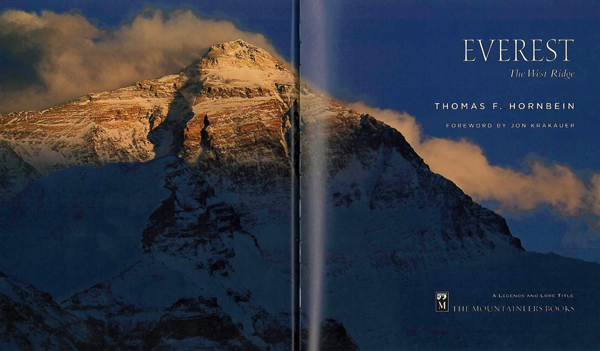
 In Everest- The West Ridge, Horbein wrote:
 "The night was overpoweringly empty. Stars shed cold, unshimmering light. The heat lightning dancing along the plains spoke of a world of warmth and flatness. The black silhouette of Lhotse lurked half-sensed, half-seen, still below. Only the ridge we were on rose higher, disappearing into the night, a last lonely outpost of the world."

Climbers on the West Ridge of Everest Photo:
Barry Bishop from Everest The West Ridge
Amazingly, despite all odds the climbers survived to greet the icy dawn.  National Geographic photographer Barry Bishop writes that it was one of finest mornings he had ever seen  but he  and his camera was too frozen to take a single photograph.

But the bivouac took a heavy toll. Unsoeld lost nine toes to frostbite and Bishop six. Jerstad and Horbein were extremely lucky to get away unscathed.

Since the first West Ridge climb in 1963, there have been about sixty attempts on the route with about half a dozen successful climbs including the West Ridge direct. The number of deaths and the number of summiteers on this route have been about the same making it one of the hardest routes on Everest.

In 2012  two teams from the USA  including crack climbers like Conrad Anker, Cory Richards, Jake Norton and David Morton  attempted the west ridge to commemorate the 1963 expedition. Unfavourable conditions forced both teams to give up the west ridge route.

In 1979 Unsoeld died on an avalanche on Mount Rainier - one of the peaks he used to guide. Horbein recollects that Unsoeld and he spoke each year on May 22nd, the anniversary of their west ridge climb. After Unsoeld’s death Horbein speaks to his widow Jolene on that day.

In the end, expedition leader Norman Dyhrenfurth, though pushing for the South Col ascent gave the west ridge team full credit. Dyhrenfurth said “For years it had been the dream of mountaineers to do a major Himalayan traverse. We were particularly happy and proud that this was not only the first Himalayan traverse but that it was on Everest.”
Sunday, May 5, 2019

Everest Reflections on the Solukhumbu | Book Launch Kathmandu May 28th 2019


EVEREST – Reflections on the Solukhumbu
Published by VAJRA Books Jyatha Kathmandu pages 152 size 11.5 inches x 8.33 inches 


Photographer Sujoy Das and writer Lisa Choegyal have collaborated in their second volume, this time capturing the essence of the majestic scenery and reality of daily life in the Solukhumbu. They delve beneath the surface of the Everest region of Nepal to reveal its historical influences, hidden seasons and current pressures. A foreword by leading mountaineer Sir Chris Bonington, preface by cultural scholar Dr Lhakpa Norbu Sherpa and drawings by artist Paula Sengupta adds depth to this unusual book about a familiar destination.  The book is published on the centenary of the birth of Sir Edmund Hillary.

The book is also now available on line at the following sites:


For more information and details please email lisa@choegyal.com or sujoyrdas@gmail.com


Saturday, April 27, 2019

Ladakh | Shang Sumdo to Rumbak Trek Aug 31-Sept 7 2019


INTRODUCTION
If you are looking for a short trek in Ladakh and don't want the crowds of Markha then the five day route from Shang Sumdo to Rumbak  is extremely attractive. The route walks in the shadow of the Matho Kangri and Stok Kangri peaks with typical rolling grasslands, fast flowing rivers, wildlife and nomadic settlements of sheep and yak. The trek approach is close to Leh making this an ideal  one week vacation.


Who should join this trek?
A good choice for regular hill walkers, moderate level of fitness required. Prior trekking experience is advisable as it is a camping trek.
1) Walking times: average 5 to 6  hours walking per day.
2) Altitude: up to 4,940 metres at the passes and around 4200-4400 metres at the campsites. 
3) Terrain: for some of the time following well-travelled trails although also likely to encounter rough and rocky conditions near the passes.
4) Remoteness: the trek is in a remote mountain area but not far from the roadheads at Shang Sumdo, Matho, Stok. There is no mobile phones and wifi connectivity on the trek.

DATES
August 31st to September 7th 2019


ITINERARY

 Day 1 Fly in from Delhi to Leh and rest for the day.

Day 2 Acclimatisation rest day - visit monasteries in and around Leh.

Day 3  Leh to Shang Sumdo 3950m 
We drive from Leh to Shang Sumdo and reach in about 90 minutes.  We camp near the river and spend the day acclimatising in and around Shang Sumdo. This second acclimatisation day will help us in our future days.


Day 4 Shang Sumdo 3950m to Shang Phu 4250m 5 to 6 hours
We start our trek today - our ponies are waiting for us here and after breakfast  we start our first days walk. Today the trail ascend gradually through green fields of wheat and barley following the Shang river, flowing from south of Matho Kangri.The valley heads up a shepherds hut the grasslands around serve as grazing grounds fro yak, sheep and goats. We camp overnight at Shang Phu. There is no pass to cross.

Day 5 Shang Phu 4250m to  Gangpoche 41500m across Shang la 4940m 5 to 6 hours
The day begins with a long three to four hour climb to the Shang la through a zg zag trail. This area is home to snow leopards, bharal, marmots, golden eagle and a lot of other bird life and wildlife. The view from the top is impressive with the mountain wall of Matho Kangri 5900m just behind and above the pass. The path then descends gradually to the campsite  of Gangpoche.

Day 6  Gangpoche to Mancarmo via Matho La 4930 5 to 6 hours
This trail travels across the Gangpoche meadows until it reaches the base of Matho la 4350 metres. It then climbs the gentle slopes to the top of Matho La our second pass. The trail steadily ascends to a series of grassy slopes, Yak herders from the nearby villages live in stone settlement at the foot of the pass and the view from the pass is absolute amazing , the popular Stok kangri peak right behind.  From the top of Matho La is descends gradually for around 3 km to the campsite of Mankarmo 4480m.

Day 7 Mankarmo 4480m  to Rumbak 3900m  across Stok La 4900m  6 to 7 hours.
Today we  have a hard climb to the top of Stok La which has a spectacular view - this is our final pass and then we descend gradually to the the village of Rumbak.  We stop for a snack at a tea tent in Rumbak and then walk one hour down to the road head where our transport is wating  drive us back to Leh 2 hour drive.

Day 8 Fly back from Leh to your home city


COST
Rs 55,000 plus GST for Indian cicitzens and US $900 plus GST for foreign passports  Leh to Leh some exclusions apply - for more information do visit  http://www.southcol.com/treks-nepal/shang-stok-via-matho-la-ladakh-august-2018/

Sunday, April 21, 2019

Himalayas | High Altitude Trekking Tips

Below the Larke La pass on the Manaslu circuit
South Col Expeditions often does long high altitude treks. There is the  fourteen days Mustang trek, sixteen days around Manaslu and seventeen days in the Everest region crossing Cho La and Rhenjo La passes and the long 23 days Kangchenjunga north and south base camps from the Nepal side  to name a few.

These long treks do make it very difficult as other than the walking there is also the discomfort of high altitude, cold,  basic toilets, repetitive food and lack of creature comforts. So how do you pace yourself for a trek like this so that you are not losing heart half way through?


Here are some tips:
  • Drink plenty of water and stay well hydrated right through the walk - two to three litres a day is mandatory especially at heights above 3000 metres.
  • Sleep at night with your window or tent flap open just a crack- you need fresh oxygen to breathe no matter how cold it is!
  • If you feel breathless, often sleeping in a semi reclining position helps to ease the breathing - prop yourself  up your pillow or rucksack!
  • If you have a past history of altitude sickness you may consider starting with diamox 125 mg twice daily - consult  a physician before starting diamox.
  • Never get cold - it takes a long time to warm up once you are frozen!
  • Carry a water bottle which can take hot water - for those really cold high altitude nights put the water bottle with hot water in the sleeping bag, your toes will warm up instantly!
  • Wear layers so that you can peel on layers and take off layers depending on the weather conditions!
  • You often reach camp or a lodge in the early afternoon - carry  a book to read or music on your phone so that the evenings are not too long and boring!
  • Before a climb eat something like a power bar or chocolates - the extra energy will help you get the to the top with less difficulty!
  • Carry the essentials in your daypack - some food, warm jacket, cap, gloves, water, sun glasses, sun block cream, some essential medicines so that you can be self sufficient during the day.
  • Do not stay wet and sweaty once you reach camp - change into dry clothes immediately!
  • Walk at a speed which you are comfortable with - don't worry too much about the speed hiker ahead of you who always reaches camp first!
  • Carry trekking poles - these are essential while crossing a stream or coming down a steep ridge!
  • If you expect snow at the passes or frozen sections of the trail, a pair of microspikes can prove useful!
  • Put your gloves, socks and cap inside your sleeping bag at night so that they are warm and toasty in the morning!
  • Stop before you are exhausted - it is best to walk for forty five minutes and take  a five minute breather!

For more details on trekking in the Himalaya do visit www.southcol.com

Friday, April 12, 2019

Three Passes of Everest Trek

The top of the Rhenjo La pass - one of the three passes crossed on this trek 
The trek across the three passes in the Everest region the Kongma la, Cho la and Rhenjo la has become quite popular of late owing to the better infrastructure in terms of lodges and facilities below the passes. Having said that it can be quite an ardous trek as all the passes are well over 5000 metres in altitude and good acclimatisation is a key to this trek.

For the complete photo essay  please do visit http://old.outlooktraveller.com/printarticle.aspx?285825


THE INFORMATION


GETTING THERE
There are a number of flights every morning from Kathmandu to the mountain airstrip of Lukla, the start of the trek. Tara Airways (www.yetiairways.com), Summit Air and Sita Air  all run the maximum number of flights to Lukla. The fare is presently USD 360 for foreigners and USD 270 return for Indian citizens.  In bad weather, Lukla flights get disrupted and the only option then is to take a seat on a helicopter (www.simrikair.com.np) back to Kathmandu (USD 450-500 one way). 
Update - Due to the Kathmandu airport being closed from April 1 2019 from 10 pm to 8 am daily Lukla flights are going from Manthali airport Ramechap. It takes 4-5 hours to drive from Kathmandu to Manthali. There are basic hotels in Manthali where you can spend a night. 

PREPARATIONS
The best season for the trek is April to Mid May and again from Mid October to early December. Though the passes are crossed later in the season as well, there is always the possibility of heavy snowfall closing down the route. If there is heavy snow during the trek, the passes are best avoided and the route can be done by following the valleys instead. We trekked in late April and were rewarded with a riot of mountain flowers including the rhododendron in the valleys capped by the soaring peaks. Bottled mineral water is available but very expensive, so please carry iodine/chlorine water purification tablets. You need to carry enough water with you at least one litre at a time and this can be refilled at the lodges. Trekking poles are a must as there are three passes to cross with slippery trails and scree.  The tea houses (lodges) will provide beds and quilts but a warm three season plus sleeping bag is essential. The trek crosses 5400 metres so do not underestimate the effects of the altitude or the walk. This is a difficult trek and you need to be fit and properly acclimatized to succeed.

Thursday, April 4, 2019

Bhutan | Photographs from the Land of Happiness

Prayer wheels at Chimi Lakhang near Punakha
I was in Bhutan last month and also did the Druk Path trek which we could not finish due to heavy snow.  Here are some photographs from this beautiful country.

Taktshang  Tigers Nest Monastery

Prayer wheels made out of bottles Tigers Nest in the background

Close up of a prayer wheel

Students working on wood carving at the Zoric Chisum Institute Thimpu

Punakha Dzong in the late afternoon

Doorway at Punakha Dzong

Chortens at the Dochu La pass

A woman leaves the butter lamp room at the Changangkha Lakhang in Thimpu

Dechen Phodrang interior Thimpu

Entrance to a restaurant Paro

Paro valley in the autumn with paddy ready for harvesting

Drying red chillies in a Paro street

Paro Dzong and the National Museum (on top) at night

Bonde Lakhang outside Paro

Thursday, March 28, 2019

Everest Reflections on the Solukhumbu


I spend five days at Archana Press Okhla, New Delhi printing our new book Everest - Reflections from the Solukhumbu.

The book will be launched on May 28th 2019 at Kathmandu.

The details of the book are:
EVEREST
Reflections on the Solukhumbu
Photographs by Sujoy Das | Text by Lisa Choegyal
Foreword by Sir Chris Bonington | Preface by Dr Lhakpa Norbu Sherpa

Drawings by Paula Sengupta

Some  photographs from the press while printing the book are below.


To find out more about the book and the release dates etc. do email me at sujoyrdas@gmail.com


LinkWithin

Related Posts Plugin for WordPress, Blogger...